High-Functioning Anxiety: 10 Signs You Shouldn’t Ignore
You meet every deadline. You exceed expectations. You show up composed and in control. Then, when you are finally alone, the second-guessing begins, the what-ifs multiply, and sleep will not come. What the world reads as ambition, strength and reliability may in fact be anxiety in its most polished form: high-functioning anxiety.
High-functioning anxiety is not an official diagnosis in the DSM-5, yet it is one of the most common and least discussed experiences among high-achieving adults. It lives in the gap between a flawless performance and private distress, and it is easy to miss precisely because it appears to work.
As a clinical psychologist, I have worked with many people who spent years, sometimes decades, explaining their symptoms away as personality traits (“I am just a perfectionist”) or lifestyle demands (“I am just busy”). The reality is more nuanced, and far more worth talking about.
High-functioning anxiety does not announce itself with panic or paralysis. It whispers through perfectionism, people-pleasing, and a productivity that never brings peace.
What Is High-Functioning Anxiety, Really?
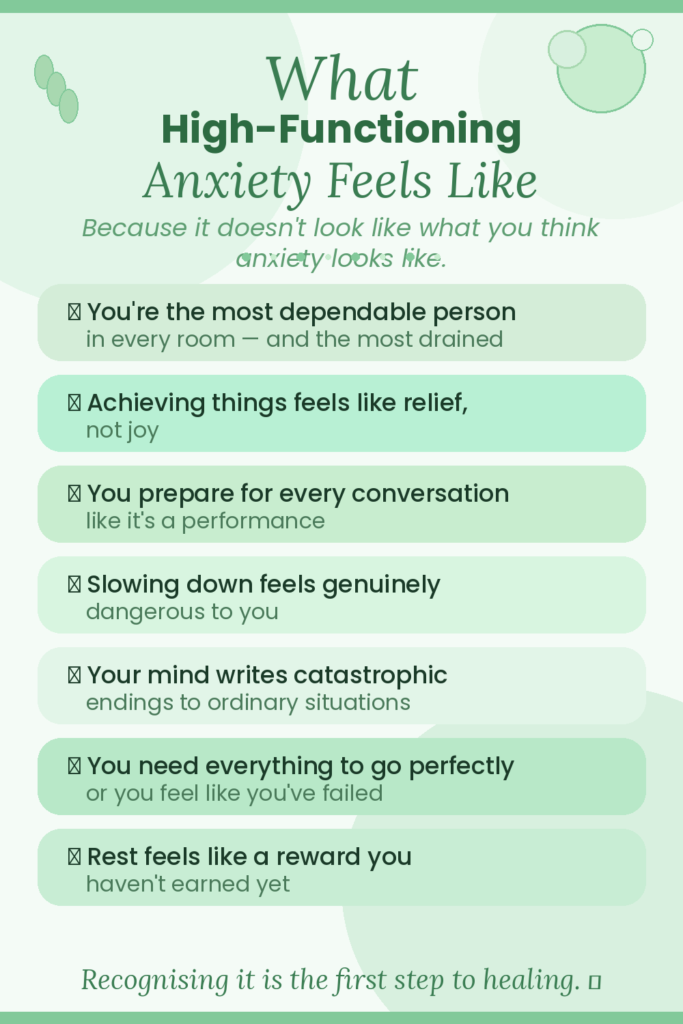
High-functioning anxiety describes a person who experiences the familiar features of anxiety, such as excessive worry, hypervigilance, catastrophic thinking, muscle tension and disturbed sleep, while continuing to meet or exceed expectations at work and in life.
That is what makes it deceptive. There is no visible breakdown to prompt anyone to seek help. The worrying pays off, at least outwardly: promotions arrive, and colleagues praise your attention to detail. Meanwhile, the private cost keeps compounding.
Around 40 million American adults live with an anxiety disorder in any given year, yet most never receive professional support (ADAA, 2024).
10 Signs of High-Functioning Anxiety You Should Never Overlook
These signs are drawn from clinical practice and the research literature. The aim is not to pathologise ambition, but to offer a compassionate lens on patterns that may be costing you more than you realise.
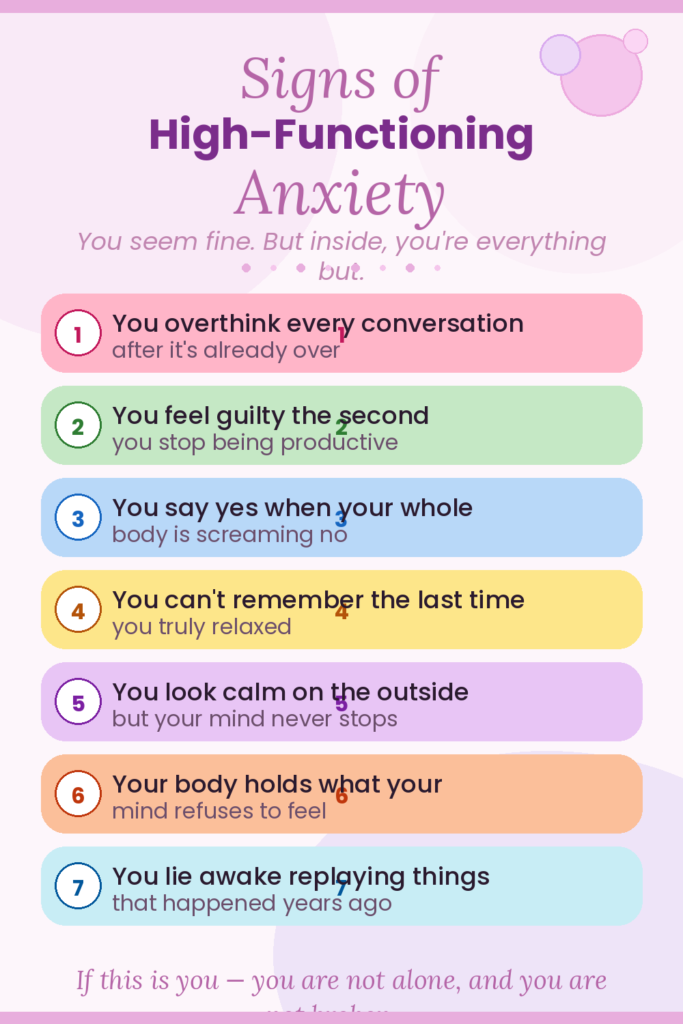
- Relentless overthinking. You replay conversations, dissect emails and rehearse every possible outcome. A quiet mind feels not just difficult but unsafe.
- Perfectionism disguised as high standards. Anything short of ideal triggers a shame spiral that can last for days, even when the result was objectively good.
- Chronic people-pleasing. Saying no feels physically threatening. You over-promise, over-explain and over-apologise to avoid any chance of rejection.
- Guilt when you rest. Leisure feels unearned. Even on holiday your internal scanner stays on, as if your worth disappears the moment you stop performing.
- Racing thoughts and disrupted sleep. The moment your head hits the pillow, unfinished tasks, worst-case scenarios and conversations you would handle differently take over. Restorative sleep feels out of reach.
- Calm outside, chaos inside. Colleagues call you unflappable. Underneath, your nervous system is on near-constant alert, and that vigilance is exhausting.
- Hyper-productivity as a coping tool. Staying busy is not a preference, it is protection. The moment your schedule empties, a vague dread moves in.
- Persistent physical symptoms. Headaches, jaw pain, tight shoulders, stomach trouble, and fatigue after a full night’s sleep. The body often says what the mind has learned to suppress.
- Difficulty delegating or trusting others. You believe that if you hand something off, it will go wrong. It looks like conscientiousness but functions as anxiety, trapping you in exhausting self-reliance.
- A deep, persistent fear of failure. Not healthy motivation, but a bone-deep fear that failing would expose you as fundamentally inadequate. Success brings relief, never peace.
Why High-Functioning Anxiety Goes Undetected for So Long
Our culture rewards the symptoms. Busyness is admired, perfectionism is praised, and the person who seems to have everything under control is promoted. When the outcomes of anxiety are socially valued, nobody has a reason to ask what is driving them.
Childhood Conditioning
Many adults with this pattern learned it early, in environments where achievement was tied, openly or quietly, to affection, safety or belonging. A child who is praised mainly for performance can absorb a costly equation: “I am only worthy when I am exceptional.”
Once that belief settles in, it operates like background code, shaping adult decisions long after the circumstances that created it have disappeared.
Clinical note: Left unaddressed, high-functioning anxiety can progress to burnout, depression, panic disorder and physical health problems, including cardiovascular strain. Early attention is not a luxury; it is good preventive care.
The Physiological Signature: Your Nervous System Under Pressure
High-functioning anxiety is not only a psychological experience. Chronic activation of the hypothalamic-pituitary-adrenal (HPA) axis floods the body with cortisol and adrenaline, holding the nervous system in a low-grade fight-or-flight state.
Over time, sustained stress physiology is associated with weakened immune function, altered hormonal balance, difficulties with memory and concentration, and higher cardiovascular risk. Neuroimaging studies also show heightened amygdala reactivity in people with anxiety-related conditions. In plain terms, the brain’s alarm system becomes more sensitive and easier to trigger.
Evidence-Based Pathways Toward Healing
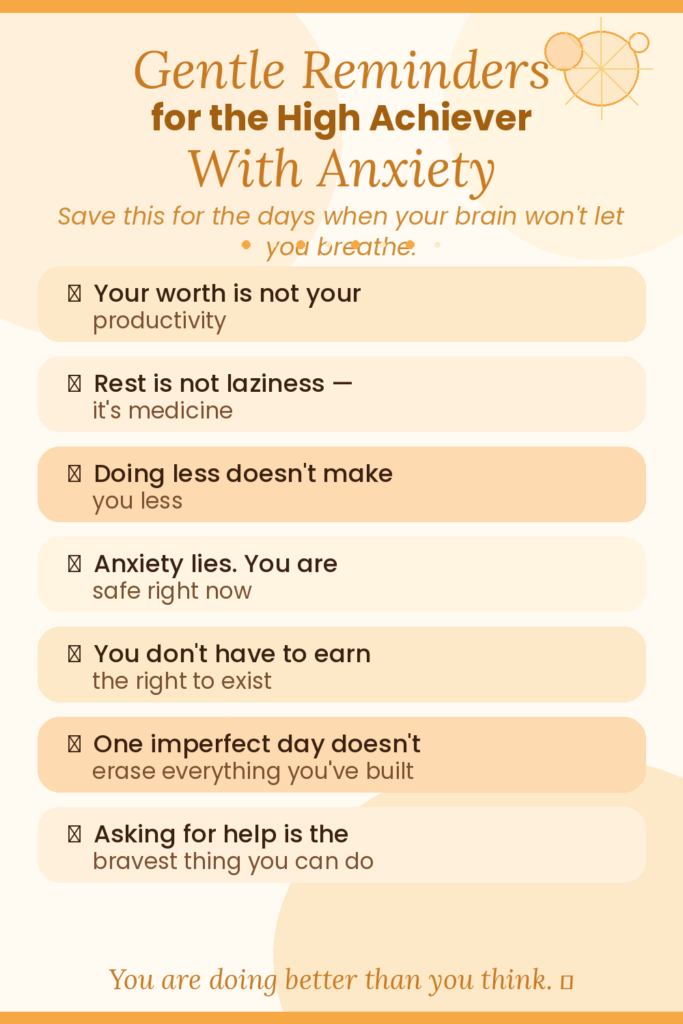
The most important thing to know is that high-functioning anxiety is not a personality trait, a character quirk or the price of success. It is treatable, and effective help does not require you to give up your ambition or your identity.
Cognitive Behavioural Therapy (CBT)
CBT is one of the best-supported approaches to anxiety. It helps people identify and restructure cognitive distortions such as catastrophising, mind-reading and all-or-nothing thinking, which fuel anxious reactions. Schema-focused strategies can be especially helpful for deeply rooted core beliefs.
Acceptance and Commitment Therapy (ACT)
ACT teaches people to relate differently to anxious thoughts. Instead of struggling against them, you learn to see them as mental events rather than facts and to refocus on values-based action. This approach suits high achievers well because it does not treat ambition as a problem; it builds a healthier relationship with achievement.
Somatic and Nervous System Regulation Practices
Because chronic anxiety has a physical side, body-based approaches make strong companions to talk therapy:
- Diaphragmatic breathing to activate the parasympathetic nervous system.
- Progressive muscle relaxation to release physical tension.
- Somatic experiencing to work through stress held in the body.
- Mindfulness-Based Stress Reduction (MBSR), an eight-week programme with a solid evidence base.
Self-Assessment Checklist
Do you recognise these patterns? Consider which of the following have been true for you over the past 30 days:
- I often replay past conversations, trying to work out what I should have done.
- I find it hard to feel proud of my achievements; relief replaces celebration.
- Saying “no” to requests fills me with anxiety or guilt.
- I find it hard to rest without feeling unproductive.
- I often have physical signs of tension, such as headaches, a tight jaw or sore shoulders.
- At night my mind fills with tasks, worries and worst-case scenarios.
- I fear that if I slow down, everything will fall apart.
- I believe I must do everything myself or it will go wrong.
If four or more of these statements resonate with you, consider speaking with a licensed mental health professional for a thorough assessment.
A Final Word: You Are Not Your Anxiety
If you see yourself in these pages, please hear this: you are not broken, you are not weak, and you are not too sensitive. You are a person whose nervous system has worked long and hard to keep you safe and successful. That deserves compassion, not criticism.
Asking yourself an honest question about what drives you takes courage. Admitting that something beneath the surface deserves attention is one of the wisest investments you can make, in your mental health, in your relationships, and in a life that feels lighter to live.
You have already proven that you can perform under pressure. Imagine what becomes possible when fear is no longer the fuel.